
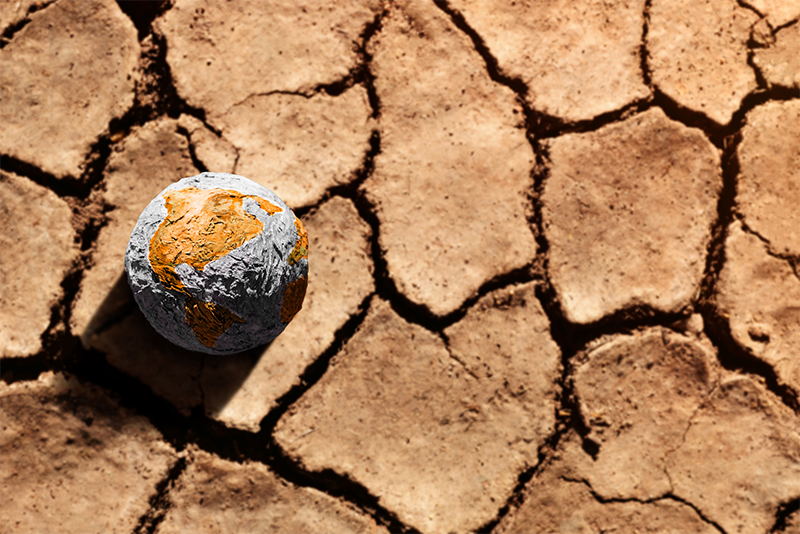
Continental Drying: A $591 Billion Opportunity for Water Technology Innovators and Investors
The World Bank’s landmark 2025 report reveals unprecedented freshwater depletion—and massive market opportunities for those ready to address the crisis
The World Bank’s ‘Continental Drying: A Threat to Our Common Future’ (2025) provides the most comprehensive analysis yet of global freshwater decline. Using 22 years of NASA GRACE satellite data, the report confirms what industry insiders have long suspected: the world is losing freshwater at an alarming rate—and the pace is accelerating.
For water technology providers, service companies, and investors, this crisis presents a compelling opportunity in a market projected to reach $591 billion by 2030.
1) The Scale of the Crisis
The report introduces ‘continental drying’—the persistent, long-term decline in freshwater reserves across vast landmasses. This isn’t seasonal variation or regional drought; it’s a fundamental shift in Earth’s water balance.
Key statistics: 324 billion cubic meters of freshwater lost annually, enough to supply 280 million people. Annual reserve decline rates of 3-10%. Groundwater depletion accounts for 68% of losses in non-glaciated regions.
Four mega-drying regions have emerged: Alaska and western Canada; the northern Russian Federation; Central America and the southwestern United States; and a vast Eurasian belt spanning Central Asia, northern China, Europe, the Middle East, and South Asia. These aren’t isolated hot spots anymore—they’ve merged into continental-scale zones of depletion.
The causes are clear. In non-glaciated regions, groundwater depletion accounts for 68% of water loss, followed by surface water (18%), soil moisture (9%), and snow (5%). Human activities—urban expansion, irrigated agriculture, underpriced water, and weak governance—are the primary drivers. Nations with weak Integrated Water Resources Management deplete freshwater 2-3x faster than those with effective frameworks.
2) The Market Opportunity
This crisis is creating unprecedented demand for water solutions. The global water and wastewater treatment market was valued at $321-350 billion in 2024 and is projected to reach $591-652 billion by 2030, with Asia-Pacific leading at 36% market share and 8.5% CAGR. The smart water management segment alone is expected to exceed $45 billion by 2032.
The strongest opportunities align directly with the crisis drivers:
Agricultural water efficiency represents the largest opportunity—agriculture accounts for 98% of global water consumption. The World Bank estimates that improving crop water use efficiency could save 137 billion cubic meters annually. Technologies include precision irrigation, soil moisture sensors, AI-driven scheduling, and deficit irrigation management.
Groundwater management addresses the dominant source of loss. Managed aquifer recharge systems, real-time extraction monitoring, and groundwater modeling platforms are seeing strong demand, particularly in South Asia and the Middle East.
Treatment and reuse is essential for supply augmentation. Membrane filtration is a $32B market by 2029; biological treatment and nutrient recovery are growing at 7.28% CAGR. Industrial water reuse systems now achieve 90%+ recovery rates.
Digital water infrastructure is explicitly recommended by the World Bank as a cross-cutting lever. AI-powered leak detection delivers 30%+ reductions; digital twins achieve 15% operational cost savings. Smart metering, demand forecasting, and satellite data integration (including downscaled GRACE data at 25km resolution) are transforming how utilities operate.
3) New Business Models
Water-as-a-Service (WaaS) enables customers to access treatment, desalination, and recycling services without capital investment—paying instead for water delivered at guaranteed quality and price. Seven Seas Water Group, a pioneer in this space with 200+ plants and 97% availability (versus industry average of 80-85%), offers build-own-operate models across the Caribbean and Latin America. Veolia provides per-volume pricing with full maintenance; Ekopak delivers containerized systems within 24 hours at 30-40% lower costs than conventional approaches.
Performance-based contracts (PBCs) tie payment to outcomes. In Ho Chi Minh City, a PBC initiated in 2009 now saves 122 million liters daily—50 Olympic pools’ worth. Manila Water’s district metered area model has achieved world-class non-revenue water reduction. According to World Bank/PPIAF analysis, PBCs are 68% more effective than utility-led initiatives. These models are now being replicated across Africa, with contracts in Addis Ababa, Togo, and Ghana.
Virtual water trade optimization addresses the finding that 25% of global water consumption is allocated for export, with 17% of exports from drying countries deemed ‘suboptimal.’ This creates demand for water footprint analytics, supply chain risk assessment, and sustainability certification services.
4) Capital Flowing to Water
Private equity is building substantial positions: KKR has its Axius Water platform and is exploring a £4B Thames Water stake; Ridgewood Infrastructure closed a $1.2B Water & Strategic Infrastructure Fund II in January 2025; WaterEquity raised $100M+ for its Water & Climate Resilience Fund with Microsoft, Starbucks, and Xylem as investors.
The White & Case 2025 survey reveals that 96% of investors plan to maintain or increase water investments; 30% deployed more than $500 million each in 2024; infrastructure funds are now deploying ~$1.3B each, approaching public sector levels; and 40% view water investment opportunities as their top priority.
5) Policy Context and Priority Regions
The World Bank’s policy recommendations—directed at national governments, water ministries, and development finance institutions—will shape where funding flows. These include water tariff reforms, groundwater licensing frameworks, PPP structures, satellite-based monitoring integration, and incorporating virtual water balances into trade policy.
Implementation varies widely. Only 38% of countries have achieved medium-high IWRM implementation according to UN-Water monitoring. Singapore and Israel stand out as leaders: Singapore’s ‘Four National Taps’ strategy and Smart Water Grid achieve among the world’s lowest water losses; Israel has achieved water independence through centralized management, 90% wastewater recycling, and innovation in desalination and irrigation—despite being one of the world’s driest countries.
The highest-stress regions combining declining supply and rising demand include the Middle East and North Africa, South Asia, the Horn of Africa, and Central Asia. Emerging stress regions—historically water-abundant but now experiencing pressure—include southeastern Brazil (Cerrado), northern China, the southwestern United States, and Eastern Europe. Asia-Pacific leads market growth at 36% share and 8.5% CAGR, driven by rapid urbanization, industrial expansion, and government mandates in China and India.
The empirical case is now established. Continental drying is reshaping global freshwater availability, with profound implications for economies, agriculture, and human settlement. Organizations that can navigate regulatory complexity, demonstrate technology value, and deploy patient capital will capture value in a market that underpins human health, industrial resilience, and environmental sustainability.
Sources: World Bank Continental Drying Report (2025); BCC Research, Grand View Research, Precedence Research, Fortune Business Insights (market data); White & Case Currents of Capital 2025; World Bank PPIAF; UN-Water SDG 6.5.1 Monitoring.