
The Unfolding Water Revolution: China’s RO Membrane Ascent and the Remaking of Global Water Treatment
In brief
China’s reverse osmosis membrane production capacity grew more than 30-fold between 2014 and 2024 and is projected to reach about 436 million m² a year by 2029. The resulting fall in cost and rise in performance are widening access to advanced water treatment worldwide — reshaping the strategies of technology providers, operators, investors and policymakers.
At a glance: what it means
- Technology providers — differentiate through system integration, specialised applications and services, not membranes alone.
- Water treatment operators — re-evaluate upgrade business cases at today’s component costs.
- Investors — value is shifting from commodity membranes to specialised applications and system optimisation.
- Policymakers — cheaper advanced treatment makes higher water quality and reuse standards more achievable.
China’s RO membranes have moved in barely a decade from cheap imports to the technology quietly reshaping global water treatment. We are witnessing a silent yet profound revolution reshaping the landscape of global water treatment. While headlines often focus on water crises, a transformative shift is underway behind the scenes: China’s unprecedented expansion in reverse osmosis (RO) membrane production. This isn’t merely a story of manufacturing prowess; it’s a fundamental redrawing of the economics and accessibility of clean water solutions worldwide.
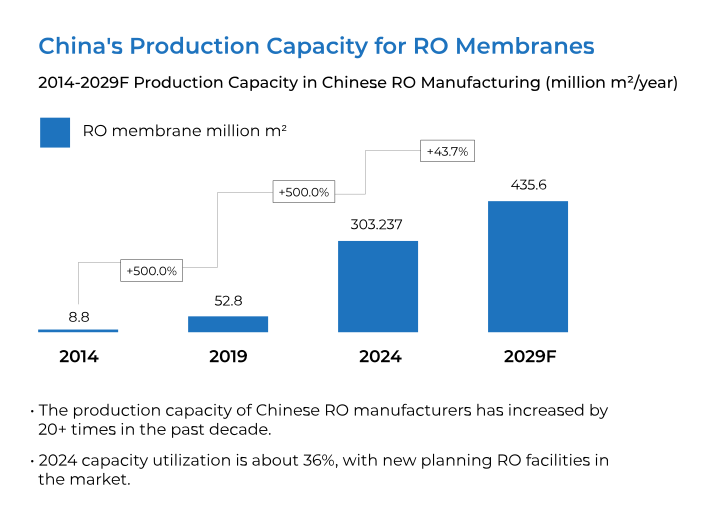
Consider the sheer scale of this transformation. From a production capacity of 8.8 million m² in 2014, China reached around 303 million m² in 2024 and is projected to reach a staggering 435.6 million m² by 2029 – more than a 30-fold increase in a single decade (Apstech Advisors analysis of industry data). By 2022, China had already captured an estimated 30 percent of the global market share. These numbers signify more than just industrial growth; they herald a democratization of advanced water treatment technology, making previously cost-prohibitive solutions increasingly accessible to regions and communities that have long been excluded.
The implications extend far beyond mere output. China’s RO membrane sector is challenging the traditional notion of manufacturing expansion prioritizing quantity over quality. The intense competition within the sector has become a powerful catalyst for innovation, driving manufacturers to not only scale up but also to differentiate through technical advancements. This has led to an accelerated development of membranes with enhanced rejection rates, lower energy consumption, and greater durability – improvements that directly translate to more efficient and sustainable water treatment systems. The innovation cycles, once measured in decades, are now unfolding in mere years.
Perhaps the most significant impact lies in the fundamental restructuring of water treatment economics. As membrane costs decline and performance improves, the financial calculus for water treatment projects globally is being rewritten. Projects previously deemed financially unviable in developing regions are now within reach. Municipal systems can consider upgrading to more advanced treatment technologies without crippling budgetary constraints. Industrial users can implement higher-standard water recycling systems with compelling return-on-investment timelines. This shift is particularly critical for regions facing acute water stress, where economic limitations have historically hampered the adoption of advanced treatment. The implications for global water security are substantial, as more communities gain access to technologies capable of transforming unusable water sources into safe, potable water.
This manufacturing revolution is also creating significant ripple effects throughout the broader water treatment ecosystem. We are observing:
- An acceleration in the development of complementary technologies designed to maximize membrane performance.
- The emergence of specialized service providers focused on the optimization of membrane systems.
- The rise of new business models, such as treatment-as-a-service, leveraging lower component costs.
- A growing emphasis on educational initiatives aimed at building technical capacity in regions adopting these technologies.
This ecosystem development fosters a self-reinforcing cycle of innovation and adoption that extends far beyond the factory floor.
For industry leaders across the water treatment value chain, this transformation presents both opportunities and challenges. The strategic imperatives are clear:
- For Technology Providers: Differentiation will increasingly hinge on system integration expertise, specialized applications, and value-added services, rather than solely on membrane technology. Strategic partnerships that leverage China’s manufacturing scale while maintaining innovation leadership will be crucial.
- For Water Treatment Operators: The changing economics of system upgrades present significant efficiency opportunities. Re-evaluating treatment approaches with current component costs may reveal previously unforeseen business cases for advanced membrane systems.
- For Investors: The locus of value creation is shifting within the water treatment sector. While commodity membrane production may face margin pressure, specialized applications and system optimization represent burgeoning areas of opportunity. Understanding these dynamics is vital for identifying attractive investment targets.
- For Policy Makers: The increasing economic viability of advanced treatment technologies allows for a potential raising of standards for water quality and reuse. The technological constraints that once limited policy ambitions are rapidly diminishing.
Looking ahead, the most profound impact of China’s RO membrane expansion may well be the transformation of water treatment possibilities worldwide. We appear to be approaching an inflection point where advanced membrane treatment transitions from a premium option to the new baseline. Forward-thinking organizations must now shift their focus from whether to adopt membrane technology to how to leverage this democratization to create new value propositions and address previously intractable water challenges. The coming decade will likely witness membrane-based water treatment systems deployed in contexts and regions once deemed impractical, bringing both new challenges in system design, operation, and maintenance, as well as unprecedented opportunities to tackle water scarcity and quality issues at scale.
In conclusion, the exponential growth in China’s RO membrane production capacity is far more than a manufacturing success story; it is a fundamental reshaping of the possibilities within global water treatment. While the wider adoption of this in markets outside China is to be seen yet, for industry leaders, the imperative is to adapt strategies to this new reality, embrace the opportunities it creates, and lead the transformation of water treatment approaches worldwide. Those who recognize this shift not merely as a supply chain development but as a catalyst for reimagining water treatment will be best positioned to lead in an industry undergoing its most significant transformation in decades. The question is not whether this transformation will occur, but who will lead it.
Frequently asked questions
Why does China’s growth in RO membrane production matter?
China’s reverse osmosis (RO) membrane production capacity grew from about 9 million m² in 2014 to about 303 million m² in 2024, and is projected to reach about 436 million m² by 2029 (Apstech Advisors analysis of industry data). Greater scale and intense competition are lowering costs and speeding up innovation, making advanced membrane treatment affordable for more projects and regions.
How is this changing the economics of water treatment?
As membrane costs fall and performance improves, projects once seen as financially unviable — particularly in developing and water-stressed regions — become feasible. Municipal systems can consider upgrades, and industrial users can justify higher-standard water recycling with stronger returns on investment.
What does it mean for water technology providers and investors?
In our view, value is shifting away from commodity membrane production, which may face margin pressure, towards system integration, specialised applications, optimisation services and new models such as treatment-as-a-service. This is market commentary, not investment advice.
Have Chinese RO membranes been widely adopted outside China?
Not yet at scale. Wider adoption in markets outside China is still to be seen, but falling costs and improving performance suggest membrane treatment is moving from a premium option towards the baseline.
Sources
Production capacity and market share figures: Apstech Advisors internal analysis of industry market data (not publicly available). Analysis and outlook: Apstech Advisors.

Vinod Ramachandran
Managing Director, Apstech Advisors
www.linkedin.com/in/viviri