
Water as an Asset Class: Why the Opportunity Is the Water Economy, Not the Molecule
Insights · Water investment
Water as an asset class is real — but it is the water economy, not the molecule. What the financialization of water means for investors and water technology companies.
Key takeaways
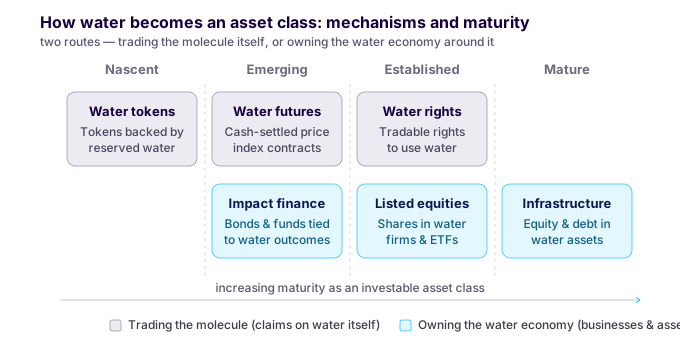
- Water is becoming an investable asset class, but through infrastructure and equity — not by trading the molecule itself.
- The direct-commodity routes (futures and digital tokens) have failed to gain liquidity; water rights work only locally, where property rights and a regulator exist.
- The deepest capital is flowing into water infrastructure and the listed water economy — utilities, treatment, technology and monitoring.
- Investors should build the thesis around the water economy; water companies should position around investable, contracted or regulated cash flows.
In 2011, Willem Buiter, then chief economist at Citigroup, made a forecast that has been repeated at almost every water investment conference since. Water, he wrote, would become “the single most important physical commodity-based asset class” — one that would in time dwarf oil, copper, farm goods and precious metals. He set out the route it would travel: a wave of investment in supply, desalination, storage and transport; then integrated spot markets for raw water; and finally a full suite of derivatives — futures, options and swaps — with different grades of water trading against one another, much as light sweet and heavy sour crude do today.1
Fifteen years on, that forecast is worth revisiting, because it is half right in a way that matters commercially. Water has become something investors can own and price. But it is maturing as infrastructure and equity, not as a commodity you trade on a screen. For anyone deploying capital into the sector, or trying to sell into it, the distinction is not academic. It tells you where the durable opportunity sits, and where the headlines are pointing you wrong.
The molecule has resisted the market
The first serious attempt to build Buiter’s market arrived in December 2020, when CME Group listed the world’s first water futures contract, settled against an index of California water-rights prices that had been running since 2018.2 The idea was reasonable: a farmer or a manufacturer could hedge water-price risk without ever handling a drop. The market never materialized. Research in Applied Economic Perspectives and Policy found monthly trading volume sitting between roughly sixty and three hundred contracts, against a rule of thumb that a functioning futures market needs more than a thousand contracts in a single day.3 The reasons are structural. Water is not fungible across basins, it is heavily regulated, it is expensive to move, and the California contract has no physical delivery at all. Without real hedging demand, the market stalled and has stayed thin.
The same ambition has resurfaced in newer packaging. In June 2025, Dubai’s DMCC signed a memorandum of understanding to develop what was billed as the world’s first digital token backed by freshwater held in reservoirs, intended to let investors trade and even take delivery of water as a commodity.4 It is the futures dream rebuilt on a blockchain, and for now it remains an announcement rather than a working market. The instinct to make the molecule itself tradable is persistent, but it has not survived contact with how water behaves.
There is one genuine exception, and it is instructive for due diligence. Water rights — the legal entitlement to use water within a defined system — do trade, and in places they trade well. Australia’s Murray–Darling Basin runs the most developed water market in the world, with entitlements valued at around thirty-two billion Australian dollars in 2025 and annual turnover in the billions.56 The western United States is extensive if more fragmented: every western state permits trading, and California alone has seen close to four billion dollars of water change hands through market transactions over the past decade.7 Chile has allowed freely tradable water rights since its 1981 Water Code, and China has been building a water-rights trading system since the turn of the century.8 The common thread is the lesson: these markets function only where property rights are clearly defined and a regulator stands behind them, and every one of them is local. There is no global water-rights market. They also carry real risk — researchers have likened Australia’s lower-security entitlements to sub-prime mortgage bonds, priced on the assumption that the past predicts a future that climate change is rewriting.9 Water trades as an asset, then, but only inside a specific legal architecture, and only within its own basin.
Where the capital has gone instead
While the molecule resisted financialization, a much larger market formed around it. The investable thing turned out not to be water, but the companies and assets that supply, treat, move, measure and conserve it — and this is where the opportunity for both investors and water businesses actually lies.
The most accessible layer is public equity. Thematic water indices and the funds tracking them have existed for years and behave like any other liquid allocation; Invesco’s S&P Global Water Index ETF, for example, holds around a billion dollars and posted a one-year return near ten percent to late November 2025, spread across utilities, equipment makers and treatment specialists.10
The deeper pool, and the more telling one, is infrastructure and private capital. Private equity and infrastructure houses have been consolidating water assets and building platforms: Ridgewood Infrastructure closed a water fund at 1.2 billion dollars in early 2025, above target, and firms such as KKR and Morgan Stanley Infrastructure Partners have assembled water businesses, the latter on inflation-linked, take-or-pay contracts that generate predictable cash flows.1112 The underlying asset base is substantial: in England and Wales, the regulatory capital value of the sector — the recognized proxy for its combined debt and equity — stood just below a hundred billion pounds in 2024 and above it in 2025, and the regulator approved 104 billion pounds of investment for 2025 to 2030.1312 The capital is moving now, not in theory: in March 2026, EQT, Singapore’s GIC and a New South Wales state body bought into the parent of Yorkshire Water.14 One veteran water investor describes the moment as a capital investment supercycle after generations of underinvestment, and a 2025 White & Case survey of more than three hundred senior decision-makers found water had moved from a niche concern to a strategic priority for institutional capital.1516
Between the public good and the pure return sits a third, smaller layer of structured and impact finance — instruments built to price the social and environmental value ordinary markets miss. Washington’s DC Water issued the first environmental impact bond, tying returns to measurable outcomes;17 the Nature Conservancy and RRG Capital Management built a Sustainable Water Impact Fund that closed at over nine hundred million dollars.18 This layer is still niche, but it is growing, and it exists precisely because a commodity market cannot capture everything water is worth.
That last point connects to the reason the molecule route keeps stalling. When the water futures launched, the United Nations Special Rapporteur on the human rights to safe drinking water publicly objected, warning that treating water like gold or oil invited the speculation that had inflated food prices in 2008.19 The UN recognized water as a human right in 2010, and that recognition gives any attempt to trade the molecule a political and reputational drag that conventional commodities do not carry. It is part of why the futures market stayed small, why the token is still an announcement, and why even functioning rights markets stay politically charged. For an investor, that ceiling is not a footnote; it is a structural limit on one whole route into the sector.
What this means for investors
The practical conclusion shapes how an investment thesis in water should be built. Exposure to the asset class runs through equities, infrastructure and, selectively, water rights — not through derivatives on the price of water itself. Opportunity scoping should concentrate where the capital is consolidating: regulated and contracted infrastructure with durable cash flows, the listed water universe, and the technology layers that serve them. The futures and token markets are not investable at scale, and the structural reasons for that are unlikely to change.
Where water rights do form part of a thesis, they demand basin-level diligence rather than a global narrative: their value is bounded by local legal architecture, regulatory intervention, foreign-ownership rules and, increasingly, climate risk that historic pricing understates. And a discipline on the headline numbers matters. The World Economic Forum’s much-cited estimate of a 6.5-trillion-euro water infrastructure gap is a measure of need, not of capital deployed.20 It frames the size of the opportunity, which is real, but it is not a market that already exists.
What this means for water technology and service companies
For technology providers and service businesses, the same finding points to how you position and how you sell. The capital flowing into water is buying investable asset bases — regulated utilities, contracted service platforms, treatment and reuse infrastructure. A commercial story built around that reality, with the regulated or contracted cash flows infrastructure investors recognize, is more durable than one built on water scarcity alone. The investable themes are the system around water: treatment, reuse, efficiency, digital monitoring and the businesses that own and operate networks. Companies that frame their value, pricing and go-to-market toward buyers backed by this capital — utilities and infrastructure-owned platforms — are aligned with where the money is, rather than where the slogans are.
Consolidation is active, which reshapes both growth and exit planning. With KKR, Ridgewood, EQT and others building and buying water platforms, scaleups benefit from understanding who is acquiring, on what investment logic, and how to build toward those exits. What does not pay is anchoring a commercial model to water-price markets that may never deepen.
Buiter, in the end, was half right. Water has become an asset class; he was simply wrong about which one. The molecule will not trade like crude, because the physics and the politics both forbid it. But the economy built around water has become one of the more durable themes in global markets — and the capital, and the companies, that understood this early have been compounding quietly while everyone else waited for a commodity market that never arrived.
Apstech Advisors helps investors and water technology and service companies turn this kind of market read into action — from investment thesis and opportunity scoping to commercial due diligence, growth strategy and market intelligence, across the US, Europe, India and China.
Discuss your water strategyFrequently asked questions
Is water becoming an asset class?
Yes, but it is maturing as infrastructure and equity — regulated utilities, treatment and technology companies, and the funds and private capital that own them — rather than as a commodity traded on an exchange.
Can investors trade water directly, like oil?
Largely no. The first water futures contract, launched by CME Group in 2020, never gained meaningful liquidity, and water-backed digital tokens remain at the concept stage. Water is not fungible across basins and is heavily regulated, which resists commodity-style trading.
Are water rights a real, investable market?
Yes, but only locally. Tradable water rights function in places such as Australia’s Murray–Darling Basin and the western United States, where property rights are clearly defined and a regulator stands behind them. There is no global water-rights market, and these markets carry political and climate-related risk.
Where is capital actually flowing in water?
Into water infrastructure — regulated utilities and contracted service platforms with durable cash flows — and into the listed water economy of utilities, equipment, treatment and digital monitoring companies, plus a smaller layer of impact and structured finance.
Notes and references
- Willem H. Buiter, “The Newest Commodity Asset Class Is Water,” reprinted in Namibia Economist, December 16, 2021. economist.com.na
- “CME Group to Launch First-Ever Water Futures Based on Nasdaq Veles California Water Index,” Nasdaq, September 17, 2020 (contract launched December 7, 2020). nasdaq.com
- Jingyuan Wang and Xiaoyang Wang, “Why is water illiquid? The NQH2O water index futures,” Applied Economic Perspectives and Policy 45, no. 1 (2023): 602–621. onlinelibrary.wiley.com
- “DMCC Signs Strategic MoU with AQUA-INDEX to Support First Water-Backed Digital Token,” DMCC, June 17, 2025. mediaoffice.ae
- “2025 Ricardo Water Markets Report,” Ricardo, 2025. ricardo.com
- “Introduction to water markets,” Australian Department of Climate Change, Energy, the Environment and Water (DCCEEW). dcceew.gov.au
- “Trends and opportunities in water markets in the western U.S.,” University of California (The Confluence), with WestWater Research. ucanr.edu
- Policy research on China’s water rights trading, Frontiers in Sustainable Food Systems, 2025. frontiersin.org
- “‘Sub-Prime’ Water, Low-Security Entitlements and Policy Challenges in Over-Allocated River Basins: the Case of the Murray–Darling Basin,” PMC. ncbi.nlm.nih.gov
- “Should You Invest in the Invesco S&P Global Water Index ETF (CGW)?,” Zacks, November 24, 2025. via sharewise.com
- “Private equity’s expanding role in the water sector,” Smart Water Magazine (BlueTech Research), April 30, 2025. smartwatermagazine.com
- “Water, and the private market responsibility,” Private Equity Wire, October 30, 2025. privateequitywire.co.uk
- “Nationalising the water sector: how we assessed the cost,” UK Department for Environment, Food and Rural Affairs (Defra), September 16, 2025. gov.uk
- “The repricing of UK water: from EQT’s bet on Yorkshire to Ofwat’s enforcement wave,” Smart Water Magazine, May 20, 2026. smartwatermagazine.com
- “Water works: Private capital is stepping in,” NOVA Infrastructure / Institutional Investing in Infrastructure (quoting Matt Diserio, Water Asset Management). novainfrastructure.com
- “Currents of Capital 2025: Rising tide — growth projections for water investment,” White & Case, May 12, 2025. whitecase.com
- “Environmental Impact Bond,” DC Water. dcwater.com
- “NatureVest” and the RRG Sustainable Water Impact Fund, The Nature Conservancy. nature.org
- “Water is not a commodity and financial asset to be exploited, says UN human rights expert,” UN Office of the High Commissioner for Human Rights (OHCHR), 2021. ohchr.org
- World Economic Forum, Bridging the €6.5 Trillion Water Infrastructure Gap: A Playbook, December 2025. reports.weforum.org